“EXW, FOB, CIF, DDP…”
When you see a price quote from a Chinese factory, do these three-letter acronyms make your head spin? You are not alone.
International trade terms (called Incoterms) define who pays for shipping, who handles insurance, and most importantly, who takes the risk at each stage of the journey.
As a bag manufacturer in Baigou serving clients worldwide, we see many startups make the same mistake: choosing the “cheapest” price on paper, only to get hit with expensive surprise fees at their local port.
For 90% of our bag buyers, the choice comes down to just two options: FOB and DDP.
Which one saves you more money and stress? Let’s break it down in plain English.
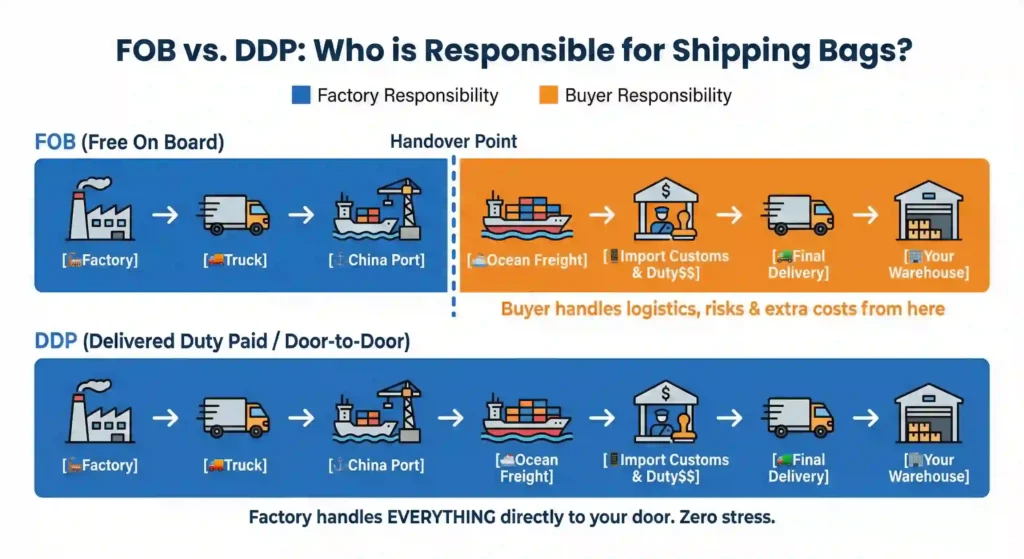
FOB (Free On Board) – The “DIY” Option
FOB is the industry standard for traditional international trade. When we quote you an FOB Price, it means:
- We (The Factory) are responsible for: Manufacturing the bags, trucking them to the Chinese port (usually Tianjin or Shanghai), and handling China’s export customs.
- You (The Buyer) are responsible for: Everything else. You must hire a freight forwarder to book the ship/plane, handle customs clearance in your country, pay import duties, and arrange the truck delivery to your warehouse.
Think of it like buying furniture at IKEA: The store prepares the boxes, but you have to drive your truck there, load it up, and drive it home yourself.
Who is FOB for?
- Experienced importers.
- Large buyers ordering Full Containers (FCL).
- Companies that have a trusted freight forwarder.
The Pros
- Control: You choose your own shipping line and schedule.
- Cost Transparency: You know exactly how much you are paying for the product vs. the shipping.
- Lower Unit Price: The factory price looks lower because it doesn’t include sea freight.
The Cons
- Hidden Costs for Small Orders: If you are buying a small batch (LCL – Less than Container Load), the destination port fees (unloading, documentation, warehousing) in your country can be surprisingly high—sometimes more than the sea freight itself!
- Headache: If customs holds your goods, you have to solve it yourself.
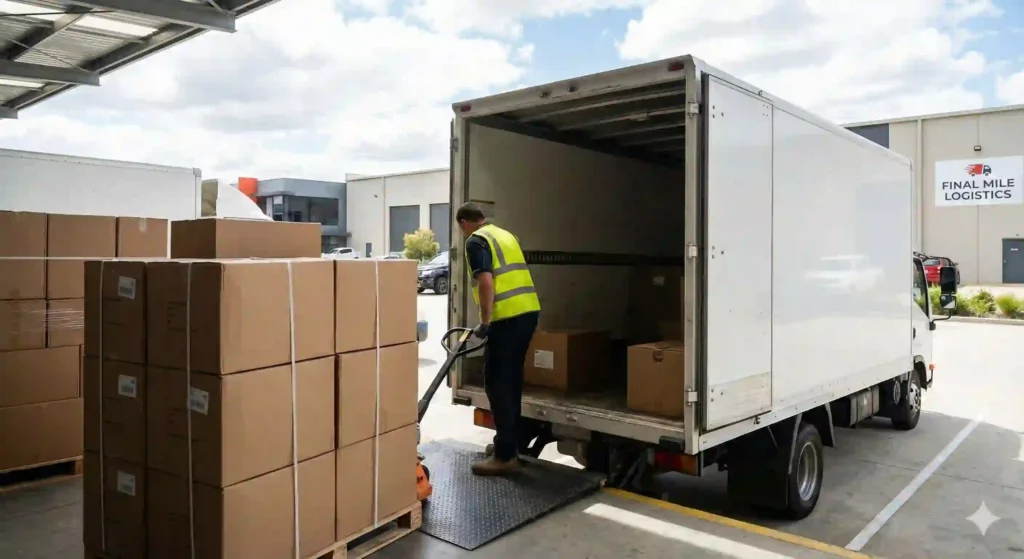
2.DDP (Delivered Duty Paid) – The “Door-to-Door” Option
DDP is becoming the favorite choice for e-commerce sellers and startups. When we quote you a DDP Price, it means:
- We (The Factory) are responsible for: Everything. Manufacturing, shipping, insurance, customs clearance in your country, paying the import taxes/duties, and delivering the boxes to your doorstep.
- You (The Buyer) are responsible for: Waiting for the doorbell to ring.
Think of it like ordering from Amazon: You pay one final price, and the package arrives at your house. You don’t care which ship it was on or how it got through customs.
Who is DDP for?
- Startups and First-time importers.
- Amazon FBA Sellers (We ship directly to Amazon warehouses).
- Buyers without an import license.
The Pros
- Zero Stress: We handle the paperwork and tax payments.
- Budget Certainty: The price is “All-in.” There are no surprise bills for tariffs or port fees later.
- Efficiency: We use established “Sea + UPS/FedEx” routes that are optimized for bag shipments.
The Cons
- Higher Upfront Price: Since we cover the shipping and taxes, the unit price will look higher than FOB.
- Less Control: You rely on our forwarder for the shipping schedule.
3.BagMakerPro’s Recommendation: Which Should You Choose?
We don’t want you to overpay. Based on our 18 years of exporting experience, here is our honest advice:
Scenario A: Your Order is Small (Less than 500-1000 pcs)
👉 Choose DDP.
Why? Because for small shipments (LCL), the fixed port fees at your destination make FOB very expensive per bag. Also, dealing with customs clearance for a $2,000 order is often not worth your time. With DDP, we can ship via “Sea Freight + UPS Delivery” (Matson clipper for USA, Railway/Truck for EU), which balances speed and cost perfectly.
Scenario B: Your Order is Large (Full Container / 20GP or 40HQ)
👉 Choose FOB.
Why? When you fill a whole container, the shipping cost per unit becomes very low. If you have the volume, hiring your own freight forwarder gives you better control over the logistics. We will deliver the container to Tianjin Port, and you take it from there.
Conclusion
Importing custom bags from China doesn’t have to be complicated.
- Want the lowest possible product price and have logistics experience? Go with FOB.
- Want a hassle-free, all-inclusive price delivered to your door? Go with DDP.
At BagMakerPro, we offer both. We are flexible and transparent.
Still confused? Let us do the math for you. Send us your delivery address and order quantity today. We will provide you with both an FOB quote and a DDP quote so you can compare the final landed cost yourself.