“EXW, FOB, CIF, DDP…” If a quote from a Chinese bag factory reads like alphabet soup, you are not alone. These three-letter codes are Incoterms — international trade terms that decide who pays for shipping, who handles insurance and customs, and who carries the risk at each stage of the journey.
Get the term wrong and you can lose more money on freight and surprise port fees than you saved on the unit price. For the large majority of bag buyers we work with, the real decision comes down to just two: FOB and DDP. This guide explains both in plain English, including the packaging differences that catch importers out.
FOB Explained: Where Your Risk Starts
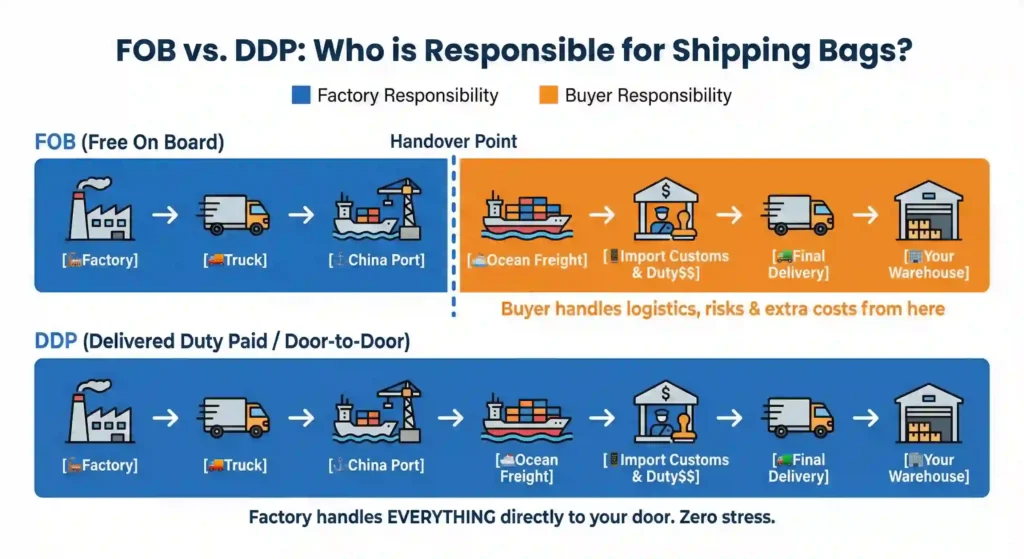
FOB stands for Free On Board and it is the traditional default in international trade. When we quote you an FOB price, it means:
- We handle: manufacturing the bags, trucking them to the Chinese port, and completing China export customs clearance.
- You handle: everything after that — booking the vessel or flight, paying freight, import customs clearance in your country, import duties, and final delivery to your warehouse.
A useful analogy: FOB is like buying flat-pack furniture from a warehouse. The seller prepares the boxes and loads them onto the truck — but you still have to arrange the truck, unload it and drive it home.
Why buyers choose FOB: it is the cheapest route on paper, it gives you full control over your own freight forwarder and shipping schedule, and it keeps the factory’s involvement cleanly separated from your logistics.
The catch: FOB prices exclude everything after the port. For a small shipment, the fixed destination charges — terminal handling, customs brokerage, delivery — get spread across very few bags, so the cost per bag can balloon.
DDP Explained: Door-to-Door, One Price
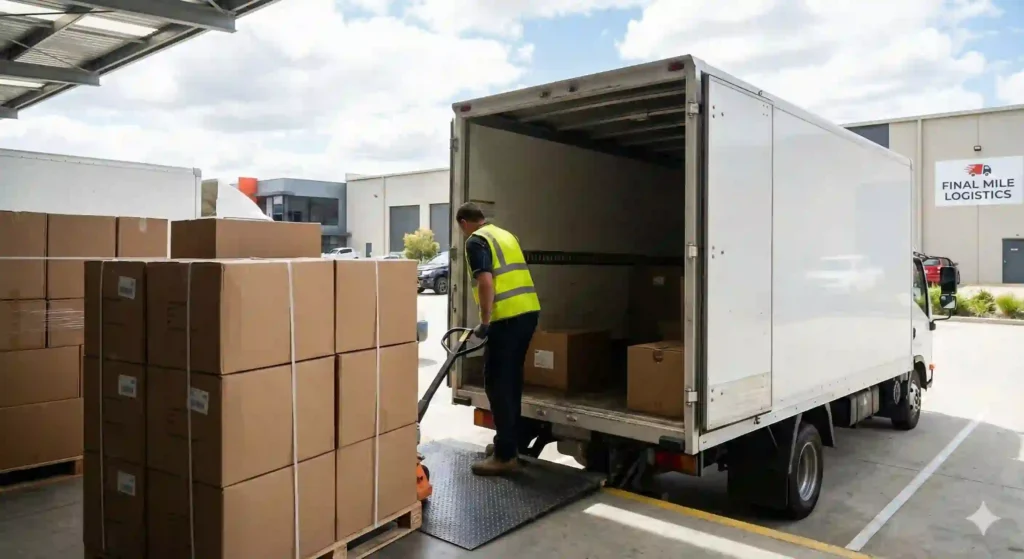
DDP stands for Delivered Duty Paid. The factory quotes you a single price that covers the goods delivered to your address, with import duties and clearance included.
- We handle: manufacturing, export clearance, international freight, import clearance, duties and taxes, and final delivery.
- You handle: receiving the cartons. That is it.
Why buyers choose DDP: budget certainty and zero paperwork. There is no separate freight invoice, no broker to appoint and no surprise customs bill months later. For a brand owner whose time is better spent on product and marketing than on logistics, that is often worth the higher headline price.
The catch: the unit price looks higher, because it now contains your freight and duties. You also have less control over the shipping schedule, since you are relying on the factory’s forwarder.
Who Pays What: A Line-by-Line Comparison
This is the table to keep next to any quote you receive:
| Cost / responsibility | FOB | DDP |
|---|---|---|
| Manufacturing | Factory | Factory |
| Trucking to port + export customs | Factory | Factory |
| International freight | You | Factory |
| Cargo insurance | You (usually) | Factory |
| Import customs clearance | You | Factory |
| Import duties and taxes | You | Factory |
| Final delivery to your address | You | Factory |
| Price certainty at quote stage | Product only | All-in, to your door |
| Control over shipping schedule | High | Limited |
| Best suited to | Full containers, experienced importers | Small orders, first-time importers |
Packaging Differences: FOB vs DDP Cartons
Packaging is where FOB and DDP quotes quietly diverge, and it is the detail most importers never ask about.
- FOB shipments are packed for the container. Cartons are optimised to fill a 20GP or 40HQ efficiently, because you are paying for the container. Carton dimensions are chosen to maximise utilisation, and master cartons may be palletised or floor-loaded.
- DDP shipments are packed for a courier network. When the final leg is a parcel carrier, cartons must survive individual handling and sorting. That usually means smaller, stronger cartons with more internal protection — and it can mean more cartons overall for the same number of bags.
- Carton count affects your duty calculation. Duties are assessed on value, but courier and clearance fees are often charged per shipment or per carton. A DDP quote that produces more, smaller cartons can carry higher handling fees.
Always ask which carton configuration the quote assumes. If you compare an FOB price built on 40 bags per carton against a DDP price built on 20, you are not comparing the same thing.
Carton marking differs too. For FOB, shipping marks are usually kept minimal because the buyer’s forwarder applies its own labels. For DDP, the factory’s carrier needs full delivery labelling — recipient address, contact number, carton count and often a barcode — printed or applied at origin. If you have specific carton artwork, barcode requirements or retailer compliance rules (maximum carton weight, for example), raise them before the quote, not after production.
How the Incoterm Changes Your Landed Cost
The only number that matters is landed cost: what one bag costs once it is sitting in your warehouse. Comparing FOB and DDP on unit price alone is misleading, because they cover different things.
To compare fairly, build the FOB number up to a landed figure:
- FOB unit price × quantity
- + international freight (get a real quote, not an estimate)
- + insurance
- + destination port and terminal charges
- + customs brokerage fee
- + import duty and any local taxes
- + final delivery to your warehouse
Then divide by the number of bags. That is your true FOB landed cost, and it is the number to compare against the DDP quote.
A worked example of why this matters. Say an order of 600 bags is quoted at an FOB unit price of $8.00 — a product cost of $4,800. Now add freight, insurance, terminal handling, brokerage, duty and final delivery. For a small LCL shipment those fixed charges can easily total $1,500–$2,500 depending on destination, which pushes the landed cost per bag from $8.00 to roughly $10.50–$12.20. The DDP quote might come in at $11.50 per bag — which suddenly looks reasonable rather than expensive.
At container volume the arithmetic flips. With 3,000 bags in a 40HQ, the same fixed charges spread across five times as many units, so the per-bag addition shrinks sharply and FOB usually wins. The Incoterm does not decide which is cheaper — your order size does.
Freight also interacts with fabric and packing choices. A heavier, higher-denier fabric raises actual weight, while bulky packing raises volumetric weight — and carriers charge on whichever is greater. If your bags are large or lightly packed, read our guide to volumetric weight in bag shipments before you fix your shipping term.
Which Term Suits a Small Importer?
Our honest recommendation, based on experience since our factory was established in 2019:
Small orders (under roughly 500–1,000 pcs): choose DDP
At low volumes you are shipping less-than-container-load (LCL). The fixed destination charges — terminal handling, brokerage, delivery — do not shrink with your order, so they dominate the per-bag cost. Add the time cost of managing clearance on a modest order and FOB stops making sense. DDP also removes the risk of a duty bill you did not budget for.
Large orders (a full 20GP or 40HQ container): choose FOB
Once you are filling a container, freight per unit falls sharply and the fixed charges are spread across thousands of bags. At that point, appointing your own forwarder gives you better rates and more control, and the factory simply delivers to the port.
Common Misunderstandings About FOB and DDP
- “DDP is always more expensive.” Only on unit price. Once you add your own freight, duties and brokerage to an FOB quote, the gap often narrows considerably — and for small orders, DDP can come out ahead.
- “FOB means the factory is not responsible for damage.” Risk transfers when the goods are on board. Damage in transit is a matter for your cargo insurance, which is exactly why we recommend insuring FOB shipments.
- “DDP means no customs involvement for me.” In most markets the importer of record still needs to exist, and duties are still paid — they are simply paid by the factory on your behalf and baked into the price.
- “The Incoterm is fixed.” It is a commercial choice, not a legal requirement. We are happy to quote both on the same order so you can compare landed cost directly.
FAQ: FOB and DDP
What is the difference between FOB and DDP in one sentence?
FOB means the factory’s responsibility ends once the goods are loaded at the Chinese port; DDP means the factory delivers to your door with duties paid.
Who pays import duty under DDP?
The factory pays it as part of the all-in price. That is what “Duty Paid” means — which is also why the DDP unit price is higher than FOB for the same bag.
Does DDP use different packaging?
Usually yes. FOB cartons are sized to fill a container; DDP cartons are sized to survive a parcel courier network, which often means smaller and stronger. Always confirm the carton configuration behind a quote.
Can I get both an FOB and a DDP quote for the same order?
Yes, and we recommend it. Send us your delivery address and order quantity and we will provide both, so you can compare the final landed cost yourself. Sampling takes 7–10 days and bulk production 25–35 days from artwork approval.
Which term is better for an Amazon FBA or marketplace seller?
Most marketplace sellers start with DDP, because the factory can deliver directly to a warehouse address and duties are handled up front — no separate customs account needed for a first order. As volumes grow and you gain logistics experience, moving to FOB and appointing your own forwarder usually reduces cost per unit.
Still deciding? Tell us your quantity and delivery address and we will run the landed-cost maths for both terms side by side — no obligation.